

Travel Essentials for Women: What Actually Earns a Spot in Your Bag
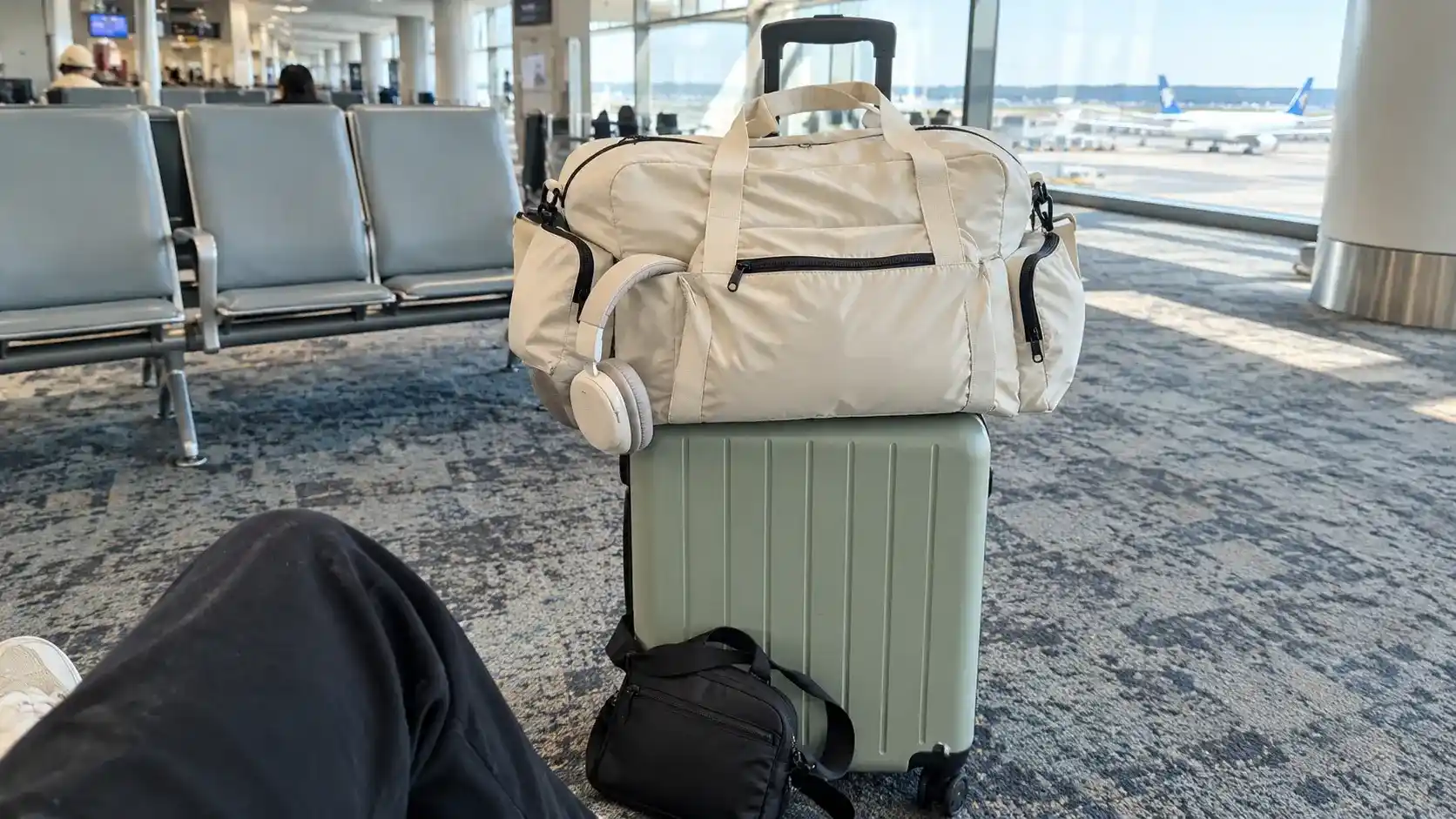
Most travel essentials lists for women have the same problem. They run to sixty products, half of which you’ll carry around the world and never touch. Then you get to the airport and realize the thing you actually needed (a pen for the arrival form, a scarf for the freezing cabin, a second charging cable) is sitting at home.
This list works differently. Every item here has to solve a problem you are likely to run into: a cramped overhead bin, dry cabin air, a hotel outlet three meters from the bed, cobblestones that eat suitcase wheels. For each one I’ll tell you who it’s for, and just as useful, who can skip it.
The rules have also shifted in 2026. Some airports now let you carry two liters of liquid while others still enforce 100 ml, and several airlines no longer let you use a power bank in flight. Those changes affect what you pack, so they’re covered in the sections where they matter.
Affiliate disclosure: The product links in this guide go to Amazon. As an Amazon Associate, tipsread.com earns from qualifying purchases, at no extra cost to you. Prices and availability change often, so check the current details on Amazon before you buy. Every section is written to be useful whether or not you click.
Short on time? The 12 essentials most women end up glad they packed
- A carry-on or travel backpack that fits your airline’s size limit (measure it, wheels included)
- Packing cubes, plus one clear pouch for liquids
- A small “seat-pocket kit” with lip balm, moisturizer, wipes, gum and a pen
- A large scarf or wrap that works as a blanket, a pillow and a cover-up
- A power bank under 100 Wh, packed in your carry-on
- Wired earbuds or a Bluetooth transmitter for seatback screens
- A universal adapter with USB-C ports
- Period products for the whole trip, even if you don’t expect to need them
- Medications in your carry-on, with a copy of any prescription
- Two pairs of broken-in walking shoes
- A crossbody bag that zips closed
- A packable rain jacket
Three questions to ask before you buy any “travel essential”
Travel gear is a category that sells on anxiety. Before adding anything to your cart, run it through these:
- What problem does this solve on my next trip? Not a hypothetical trip. If you’re spending five days in Lisbon in June, a thermal base layer is dead weight.
- Can something I already own do the job? A shower cap covers shoes in your suitcase. A sunglasses case holds earrings. A sarong is a beach towel.
- Will it get through the rules? Liquid limits, battery limits and bag sizes decide more of your packing list than personal taste. A gorgeous 40-liter duffel is useless if your airline only allows a 40 × 30 × 20 cm bag for free.
Keep those three in mind and the rest of this list gets much shorter.
Luggage, travel bags and packing organization
Your bag decides how the whole trip feels. Pick the wrong one and you’ll be hauling it up metro stairs, paying gate fees, or digging through it at every stop. The right choice depends less on brand and more on the type of trip.
| Bag type | Best for | Think twice if |
|---|---|---|
| Carry-on spinner suitcase | Business trips, resort stays, cities with smooth pavements and elevators | You’ll walk on cobblestones, use lots of stairs or take budget airlines |
| Travel backpack (35 to 45 L) | Multi-city trips, trains, island hopping, backpacking | You have shoulder or back issues, or need clothes to arrive unwrinkled |
| Duffel / weekender | Road trips, 2 to 4 night getaways, a second bag on top of a suitcase | You’ll carry it more than 15 to 20 minutes at a time |
| Under-seat personal item | Budget airline trips, minimalists, weekend city breaks | You need more than 3 to 4 days of clothes or any bulky gear |
Suitcases: hard shell, soft side, and the size trap
Hard-shell suitcases protect fragile items and shrug off rain. Soft-sided cases flex into tight overhead bins and usually have an exterior pocket for a jacket or passport. Neither is better across the board, so choose based on what you carry.
What matters more is size. A “carry-on” label on a suitcase means nothing to a gate agent. In the US, many major airlines use a limit around 22 × 14 × 9 inches, while European carriers vary a lot. Air France, for example, lists a cabin bag of 55 × 35 × 25 cm plus a personal item, with a 12 kg combined weight limit in Economy, and many budget airlines charge for anything bigger than an under-seat bag. Measure your suitcase with the wheels and handle included, then check the specific airline before every trip.
A few details worth paying for: four spinner wheels for airports (or larger, sturdier wheels for old town streets), a light empty weight, an interior compression strap, and a sleeve on the back that slides over another bag’s handle.
- Hard-shell carry-on suitcase for fragile items, rain and checked-bag-style protection.
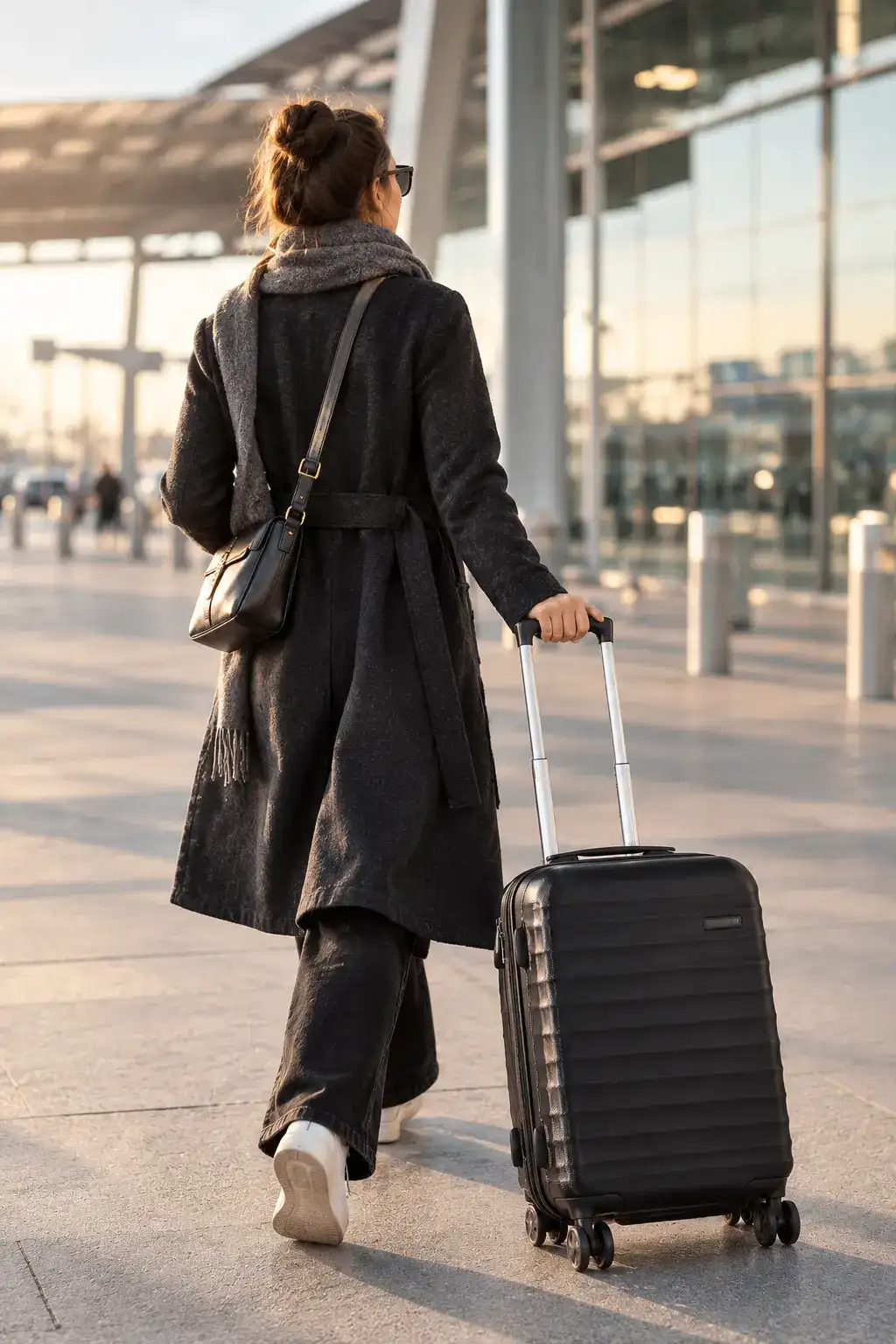 View on Amazon
- Soft-sided carry-on suitcase for squeezing into tight overhead bins, with an outside pocket for a jacket or passport. View on Amazon
- Lightweight carry-on suitcase for airlines with a 7 to 10 kg cabin weight limit. View on Amazon
- Luggage scale to check your bag’s weight before you leave for the airport. View on Amazon
Travel backpacks: the multi-city workhorse
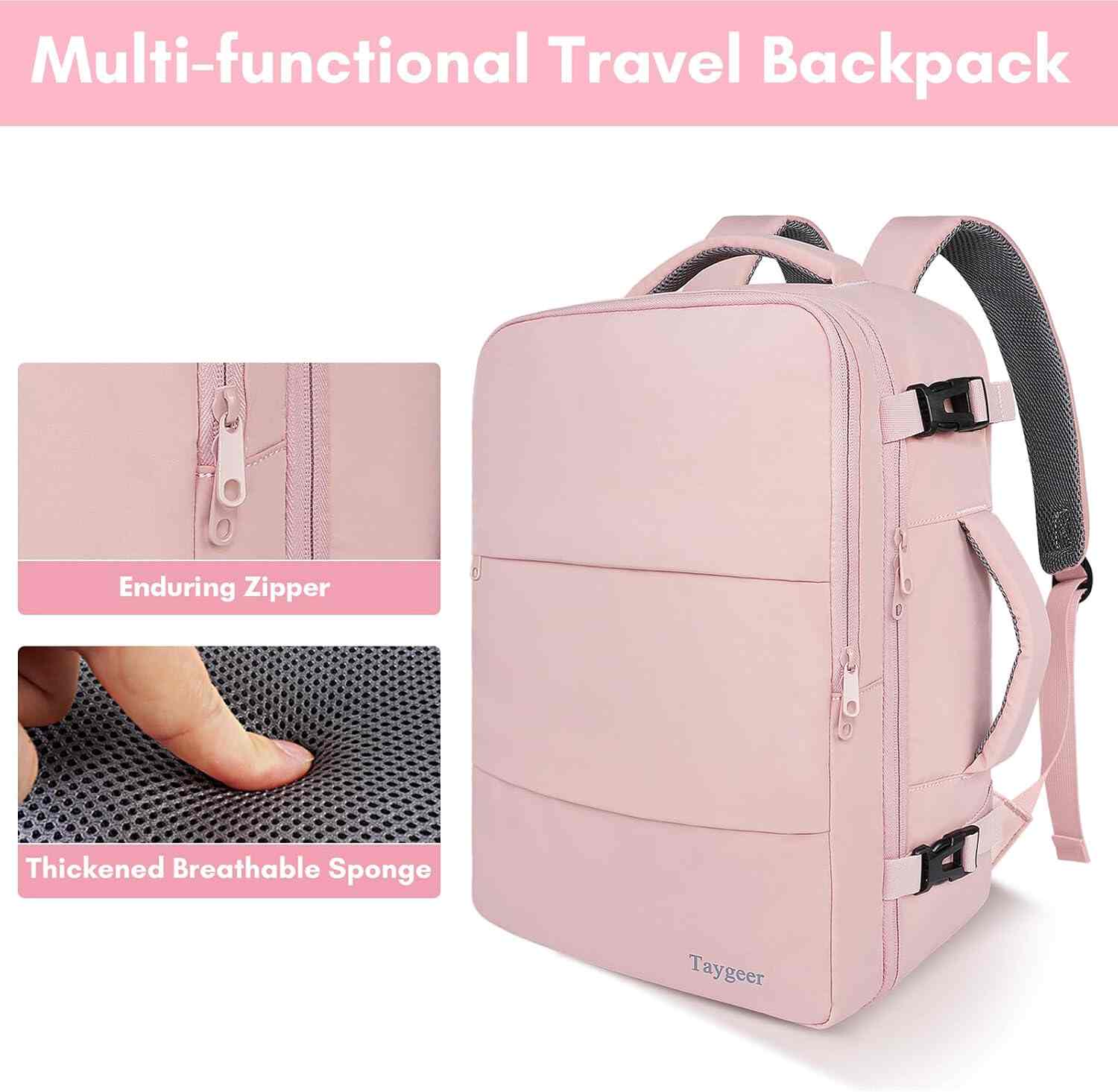
If your trip involves trains, ferries, stairs, or a different bed every few nights, a backpack is usually easier than a suitcase. Look for one that opens fully like a suitcase (often called “clamshell”) so you aren’t digging from the top.
Fit is where many women get let down. A pack sized for a longer torso puts the weight on your shoulders instead of your hips. Check the torso length range, and choose a pack with a hip belt and sternum strap if you’ll carry it for more than a few minutes. Several brands make women-specific versions with shorter torso lengths and shaped shoulder straps, so try them on with weight inside if you can.
What to look for in a women’s travel backpack
A 35 to 45 liter capacity covers most carry-on rules. A boxy rectangular shape packs more efficiently than a rounded one. A padded laptop sleeve, a trolley sleeve and a lockable main zipper are all worth having.
Worth it ifYou’re doing multi-city trips, backpacking, or anywhere with uneven streets.Skip it ifYou have back problems or mostly travel to one hotel and stay put.
- Women’s travel backpack (35 to 40 L) with a shorter torso range, hip belt and suitcase-style opening.
- Expandable travel backpack (35 to 45 L) if you want one pack for both weekend trips and longer ones. View on Amazon
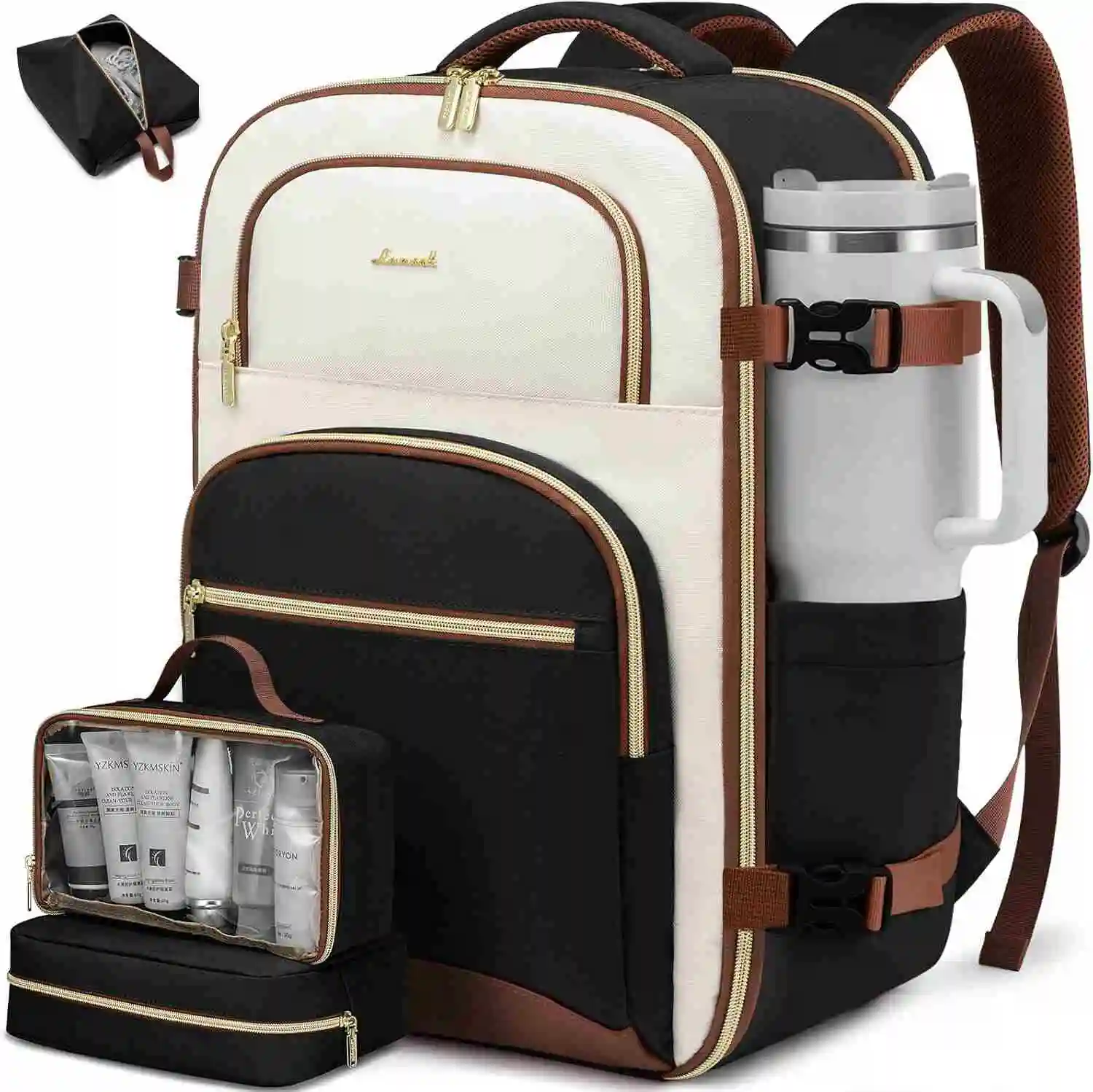
- Under-seat backpack (40 × 30 × 20 cm) for budget airline fares that only include a free personal item. View on Amazon
Duffel and weekender bags
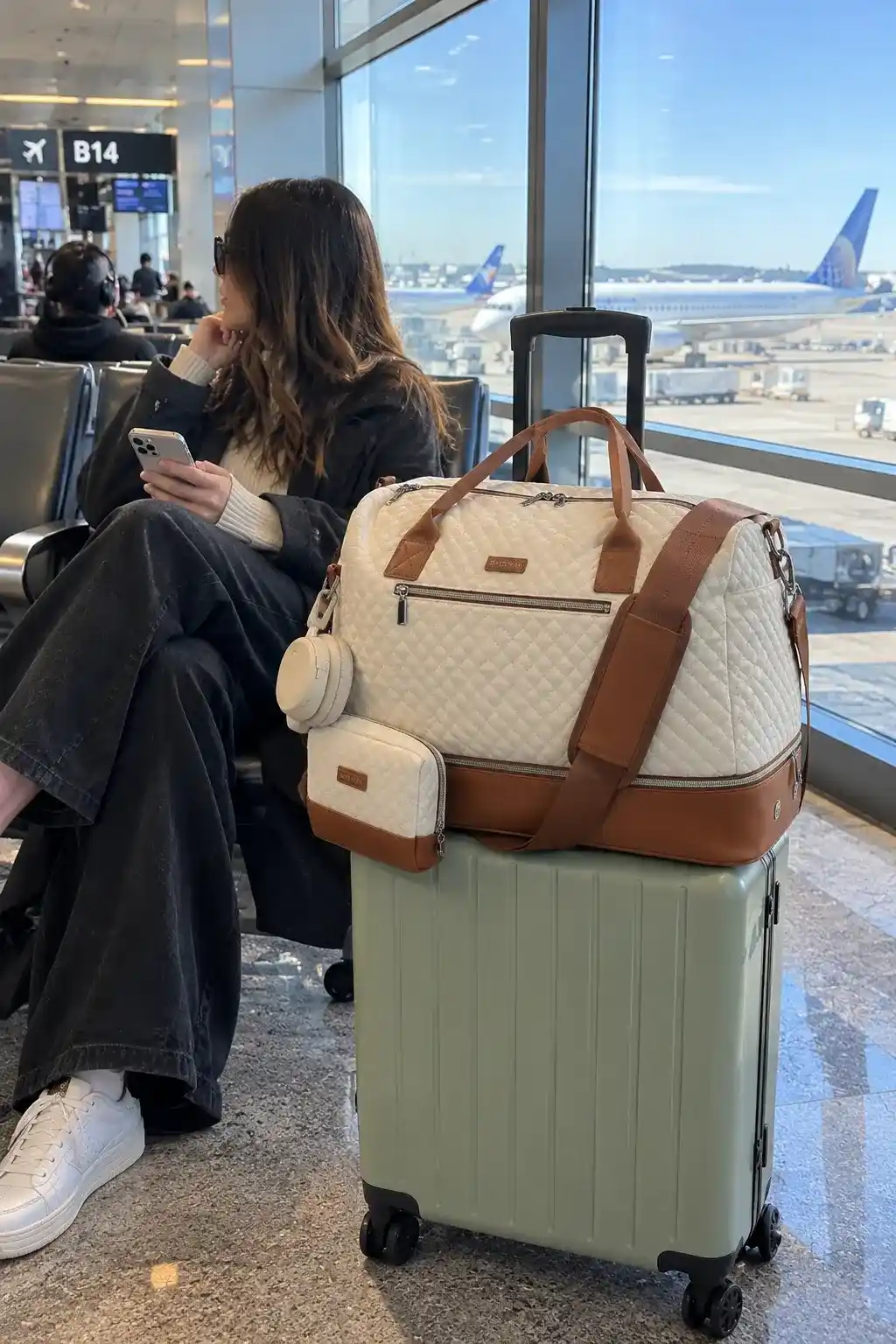
A duffel’s main advantage is that you can see everything at once when you unzip it. Good ones have a separate shoe compartment, a padded laptop sleeve and a trolley sleeve so they can ride on your suitcase through the airport.
The downside is weight distribution. All the load sits on one shoulder, which is fine for a walk from the car to the hotel and miserable on a 20-minute walk from the station. If you love the duffel style but walk a lot, look for one with backpack straps that tuck away.
- Weekender duffel with trolley sleeve that rides on top of your suitcase through the airport. View on Amazon
- Duffel with shoe compartment to keep dirty shoes away from clean clothes. View on Amazon
- Convertible duffel backpack with tuck-away straps for longer walks. View on Amazon
Budget airline check: In Europe, the free bag often has to fit under the seat. Ryanair’s free bag is 40 × 30 × 20 cm, while easyJet allows 45 × 36 × 20 cm. A soft duffel or small backpack squeezes into those sizers more easily than a rigid case.
Packing cubes and organizers
Packing cubes won’t magically create space. What they do is stop your bag from turning into one big pile, so you can find a swimsuit without unpacking everything and repack in ten minutes on checkout morning.
- Packing cubes set in mixed sizes: one for tops, one for bottoms, one for underwear and swimwear.
- Compression packing cubes with a second zipper that squeezes bulky knits flatter. Weigh your bag afterwards, because they make it easy to pass a 7 or 10 kg limit.
- Clear liquids pouch sized for airport security, so you’re not fumbling with a zip-top bag.
- Tech organizer pouch for cables, the adapter and the power bank, so nothing gets left plugged into a hotel wall.
- Hanging toiletry bag for small bathrooms with no counter space.
- Travel laundry bag to keep worn clothes away from clean ones.
Packing tip: fold clothes to the width of the cube rather than rolling everything. Rolling works for t-shirts and leggings; folding is better for structured pieces. Also, your stuff will expand to fill whatever bag you give it. Pick the smaller bag and you’ll be forced to make the decisions you’d otherwise put off.
Related: how to pack a carry-on for a week · best travel backpacks
In-flight essentials for women
A long flight is where small comforts pay off. Ten hours of recycled air and a seat that barely reclines will leave you dry-skinned and puffy-ankled unless you plan a little. None of the fixes are expensive.
Comfort and circulation
Compression socks. Long flights mean hours of sitting still, and that raises the risk of blood clots in the legs. The CDC’s travel health guidance notes that the risk on flights under four hours is negligible, but on longer flights the risk rises, mostly for people with existing risk factors. Its clinical guidance also says graduated compression stockings appear to reduce clots without symptoms and are generally well tolerated.
For women specifically, risk factors include pregnancy and hormonal birth control, alongside recent surgery and a previous clot. If any of those apply to you, talk to your doctor before a long-haul flight. Even if they don’t, compression socks help with swollen ankles, and getting up to walk the aisle helps everyone.
Worth it ifYour flight is over 4 hours, your ankles swell, or you have a clot risk factor.Skip it ifYou only take short hops and your feet feel fine afterwards.
A large travel scarf or wrap. If I could only recommend one thing on this list, it would be this. It’s a blanket when the cabin gets cold, a pillow when bunched up, a privacy screen for sleeping, and a cover-up for shoulders when you visit a church or mosque later in the trip.
Neck pillows are personal. Some people sleep through a night flight thanks to theirs; others find them bulky and useless. An eye mask, on the other hand, is tiny and almost always worth bringing.
- Compressible travel neck pillow that packs small or clips onto your bag. View on Amazon
- Contoured sleep eye mask that doesn’t press on your lashes. View on Amazon
Layers you can take off. Cabin temperature swings a lot. Wear a light sweater over a t-shirt and soft trousers or leggings, rather than one heavy item.
Build a seat-pocket kit
Pack a small pouch with everything you’ll want during the flight and pull it out of your bag before you sit down. It goes in the seat pocket so you aren’t climbing over your row mate to reach the overhead bin.
- Small travel pouch to hold the whole kit in the seat pocket. View on Amazon
- Lip balm because cabin air is very dry. View on Amazon
- Travel-size hand cream for hands that dry out after a few hours. View on Amazon
- Face mist or travel moisturizer to refresh your skin on long flights. View on Amazon
- Hand sanitizer and wipes for the tray table and armrests. View on Amazon
- Travel toothbrush kit with mini toothpaste for overnight flights. View on Amazon
- Reusable earplugs for crying babies and engine noise. View on Amazon
Add gum or mints for ear pressure on descent, tissues, period products, any medication you take during travel hours, and a pen for arrival forms.
Entertainment and power
Download everything before you leave home: shows, playlists, podcasts, offline maps and your boarding pass. Airline Wi-Fi is getting better but it’s still unreliable.
- Wired earbuds for seatback screens that still use a headphone jack. View on Amazon
- Airplane Bluetooth transmitter that lets your wireless earbuds connect to the seatback screen. View on Amazon
- Noise-canceling headphones that turn the engine roar into a hum on long-haul flights. View on Amazon
- E-reader that weighs less than one paperback. View on Amazon
- Power bank under 100 Wh for your carry-on. Read the rule box below first, because this is the item where 2026 changed things most. View on Amazon
2026 power bank rules: Power banks and spare lithium batteries go in your carry-on, never in checked luggage. Up to 100 Wh is generally allowed; 100 to 160 Wh needs airline approval. What changed is in-flight use. Since 15 January 2026, Lufthansa Group airlines don’t allow power banks to be used or charged on board and cap you at two, and Emirates allows only one. Check your airline’s page before you fly, and charge your phone fully at the gate.
Snacks and hydration
Bring an empty reusable water bottle through security and fill it at a fountain airside. Ask the crew to top it up during the flight rather than waiting for the drinks cart.
For snacks, choose things that keep you full and don’t smell strongly: nuts, protein bars, crackers, dried fruit. Eat any fresh fruit, meat or cheese before you land. Many countries restrict bringing these in, and an apple you forgot about at the bottom of your bag can turn into a fine at customs.
Related: long-haul flight tips
Toiletries and personal care
Toiletries are easy to overpack because every bottle feels small. Most hotels supply soap and shampoo, and any pharmacy abroad sells sunscreen. Bring what’s hard to replace, plus anything your skin reacts badly to swapping.
2026 liquids check: In the US, the TSA 3-1-1 rule hasn’t changed: containers of 3.4 oz (100 ml) or less, all in one quart-size bag. Newer CT scanners change how bags are screened, not how much you can carry. In the UK, Heathrow, Edinburgh, Birmingham and Bristol have lifted the 100 ml limit thanks to new scanners, but airports including Manchester, Stansted, Luton, Glasgow and Liverpool were still at 100 ml as of September 2026. Pack for the strictest airport on your route, including the flight home.
How to pack toiletries smarter
Solid products don’t count as liquids at security, and multi-use products save space. Keep a full-size duplicate kit at home so you aren’t packing your bathroom shelf every trip.
- Shampoo bar that skips the liquids bag entirely.
- Solid conditioner bar to go with it.
- Solid perfume that won’t leak or count toward your liquids.
- Silicone travel bottles for anything you must bring in liquid form. Fill them about three-quarters full.
- Tinted moisturizer with SPF that covers two steps in one
- Multi-stick for cheeks and lips for a quick, small makeup kit.
Period care
Pack enough period products for the whole trip, even if your period isn’t due. Travel, time zones and stress can shift your cycle, and your preferred brand or type (especially tampons, menstrual cups or discs) may be hard to find in some destinations. Reusable options save space on longer trips:
- Menstrual cup with a small pouch for storage.
- Reusable menstrual disc if you prefer a disc to a cup.
- Period underwear which doubles as backup protection on travel days.
Bring a few disposable products as backup too, plus small opaque bags for disposal where bins are scarce.
Medications
Keep every medication in your carry-on so a lost bag doesn’t leave you without it. Bring more than you need in case of delays, and carry a copy of your prescription. A travel pill organizer saves space, but in the US the TSA doesn’t require original bottles while some states have their own labeling rules, and some countries strictly control certain medications. Check your destination’s embassy website before you go, especially for strong painkillers, sleep aids and ADHD medication.
Hair tools and voltage
Plugging the wrong hair tool into a foreign outlet is an easy way to kill a straightener on day one. The US uses 120 V, while most of Europe, Morocco and much of the world uses 220 to 240 V. Check the label on your device:
- If it says 100 to 240 V, it’s dual voltage. You only need a plug adapter.
- If it says a single voltage (such as 120 V), plugging it into a 230 V outlet with just an adapter can damage it, and many small converters can’t handle high-wattage heat tools safely.
A dual-voltage hair tool is worth it if you travel internationally often. Many hotels provide a hair dryer, so check before you pack one.
- Dual-voltage travel straightener that works from 100 to 240 V.
- Dual-voltage curling wand small enough for a carry-on.
Small extras that earn their space
- Blister cushions for long walking days. View on Amazon
- Mini travel first-aid kit for pain relief, antihistamine, rehydration salts and plasters.
- Travel-size sunscreen if you’re heading somewhere hot.
- After-sun gel for the day you forget to reapply.
- Travel-size dry shampoo which buys you an extra day between washes.
- Compact hairbrush with cover that won’t snag everything in your bag.
Hotel room must-haves
These are the small things that make a strange room feel workable. None of them is expensive, and I’d pack most of them for a riad in Marrakech as readily as for a city apartment.
Universal adapter with USB-C ports
One adapter that works across regions and charges your phone, watch and laptop at once. Look for at least one USB-C port with enough power for your laptop if you travel with one.
Worth it ifYou travel internationally more than once a year.Skip it ifYou only travel domestically.
Extra-long charging cable (2 m)
Hotel outlets are often behind the bed or across the room. A 2-meter (6-foot) cable means you can use your phone in bed while it charges.
Door stop alarm or portable door lock
- Door stop alarm that sounds if someone pushes the door open. View on Amazon
- Portable door lock for inward-opening doors. View on Amazon
A wedge-shaped alarm under the door sounds if someone pushes it open. It’s cheap, light, and gives a lot of peace of mind when you’re traveling solo. Portable locks only work on inward-opening doors, so keep them within reach and remove them before you leave.
Worth it ifYou travel alone or stay in budget accommodation, hostels or rentals.Skip it ifYou only stay in hotels with deadbolts and security latches and feel comfortable there.
Sleep kit: eye mask, earplugs, white noise
Thin curtains and noisy corridors are common. A white noise app on your phone does the job for most people.
- Portable white noise machine if you’re a light sleeper or traveling with kids.
- Travel blackout eye mask for thin hotel curtains.
- Foam or silicone earplugs for noisy corridors.
Wrinkle release spray or mini steamer
- Wrinkle release spray that takes up almost no space and fixes most creases.
- Dual-voltage travel steamer for heavier fabrics. Check it’s rated for 100 to 240 V.
Mini laundry kit
These let you pack half the clothes and wash in the sink, which is especially useful on trips of a week or more.
- Travel laundry detergent sheets that don’t count as liquids.
- Universal sink stopper for any hotel sink.
- Travel clothesline that stretches across a bathroom.
Jewelry case and a foldable tote
- Travel jewelry case with separate slots so necklaces don’t tangle. View on Amazon
- Foldable tote bag that weighs almost nothing and handles grocery runs, beach days and souvenirs. View on Amazon
Clothes and accessories
Clothes take up most of your bag, so this is where cutting back saves the most space. Build a small wardrobe where everything mixes, instead of packing one complete outfit per day.
Travel clothes that work hard
Start with a color palette: two neutrals (say, navy and cream) plus one or two accent colors. Everything should go with everything else. Then pick fabrics that travel well:
- Women’s merino wool t-shirt that resists odor and dries quickly, so you can wear it more than once between washes. View on Amazon
- Wrinkle-resistant travel top that comes out of a packing cube ready to wear. View on Amazon
- Wrinkle-resistant travel dress that goes from day with sandals to dinner with nicer shoes. View on Amazon
- Women’s travel pants or soft joggers with a zip pocket for travel days. View on Amazon
- Lightweight leggings with pockets for long flights and train days. View on Amazon
- Lightweight cardigan for planes, buses and air-conditioned museums. View on Amazon
Think about the culture at your destination too. Many religious sites expect covered shoulders and knees, including St. Peter’s Basilica in Rome. If you visit a mosque that welcomes non-Muslim visitors, such as the Hassan II Mosque in Casablanca, plan on covered arms and legs, and bring something to cover your hair just in case. That big scarf from your in-flight kit covers most of these situations.
Weather-specific gear
For heat, pack light and loose. For rain, a packable shell beats an umbrella on windy coasts. For cold, skip the one bulky coat and layer instead.
- Foldable wide-brim sun hat that packs flat. View on Amazon
- UV-rated sunglasses for strong sun and glare off water. View on Amazon
- Sarong that doubles as a cover-up, beach towel and scarf. View on Amazon
- Women’s packable rain jacket with a hood, sized to fit over a sweater. View on Amazon
- Thermal base layer for cold trips. View on Amazon
- Packable down jacket that squashes into its own pocket. View on Amazon
- Lightweight fleece for cool evenings and mountain days. View on Amazon
Comfortable shoes
You’ll probably walk more on a trip than in a normal week at home, often on uneven surfaces. Shoes are heavy and bulky, so aim for three pairs at most, and wear the bulkiest pair on the plane.
- Women’s walking sneakers you’ve already broken in. Never take brand-new shoes on a trip. View on Amazon
- Supportive walking sandals with a backstrap for long days in warm weather. View on Amazon
- Water-resistant ankle boots for rainy or cold seasons. View on Amazon
- Comfortable flats as a dressier pair for dinners. View on Amazon
Cobblestones, hills and wet marble steps are hard on thin soles. If you need arch support at home, you’ll need it more on the road.
Accessories that look good and do a job
A crossbody bag that zips shut is the accessory I’d prioritize. Swing it to the front of your body on crowded metros and in markets, and pickpockets have a much harder job. Bring simple jewelry you wouldn’t cry over losing, and leave the sentimental pieces at home.
- Anti-theft crossbody bag with zip closures for crowds and public transport. View on Amazon
- Small daypack for sightseeing days: water bottle, sunscreen, snacks and a layer. View on Amazon
- Sling bag if you prefer something lighter than a daypack. View on Amazon
- Hard sunglasses case because a soft pouch won’t survive the bottom of a bag. View on Amazon
Safety and money essentials for women traveling solo
You don’t need a bag full of safety gadgets to travel alone. Most of what helps is habit, and it costs nothing:
- Share your live location and itinerary with someone at home.
- Download offline maps so you aren’t wandering with your phone held out looking lost.
- Set up an eSIM before you leave so you have data the moment you land.
- Split your money: one card and some cash in your bag, a backup card and emergency cash in your luggage.
- Keep a photo of your passport and insurance details in a secure cloud folder.
- Get travel insurance that covers medical care and lost luggage.
Related: solo female travel tips
What you can probably leave at home
Every item you cut is space for something on this list, or for whatever you buy on the trip.
- A full-size hair dryer. Many hotels supply one, so check the listing before you pack.
- A travel iron. Wrinkle spray or a steamer covers nearly everything.
- More than three pairs of shoes. They take up more space than anything else.
- “Just in case” outfits. If you haven’t planned when you’ll wear it, you probably won’t.
- Full-size toiletries you can buy at a local pharmacy for a few euros.
- Gadgets that only do one thing, unless that one thing solves a problem you’ve actually had.
Printable checklist: travel essentials for women
Bags and organization
- Carry-on or travel backpack (measured)
- Personal item / daypack
- Packing cubes
- Clear liquids pouch
- Tech organizer
- Laundry bag
In-flight
- Seat-pocket kit
- Large scarf or wrap
- Compression socks (long flights)
- Eye mask and earplugs
- Wired earbuds or Bluetooth transmitter
- Power bank (under 100 Wh, carry-on)
- Empty water bottle
- Snacks
- Pen
Toiletries and health
- Solid toiletries / refillable bottles
- Period products for the whole trip
- Medications + prescription copy
- Sunscreen
- Mini first-aid kit
- Blister plasters
- Dual-voltage hair tool
Hotel room
- Universal adapter
- Long charging cable
- Door alarm (solo trips)
- Wrinkle spray
- Mini laundry kit
- Foldable tote
Clothes and accessories
- Mix-and-match tops (2 neutrals + 1 accent)
- Bottoms for day and evening
- One versatile dress
- Light layer for transport
- Rain jacket
- 2 to 3 pairs of broken-in shoes
- Zip-closed crossbody bag
- Sunglasses and hat
Travel essentials for women: FAQ
What are the most important travel essentials for women?
The items that prevent the biggest problems: a bag that meets your airline’s size rules, medications and period products in your carry-on, comfortable broken-in shoes, a universal adapter, a power bank, and a large scarf for warmth and modest dress. Everything else depends on your destination and trip type.
Can I bring a hair straightener on a plane?
Generally yes, in carry-on or checked luggage. Cordless straighteners with lithium batteries have stricter rules, so check your airline. Before you travel abroad, also check whether the device is dual voltage (100 to 240 V), or it may be damaged by a 220 to 240 V outlet.
Can I bring a power bank on a plane in 2026?
Yes, but only in your carry-on. Power banks up to 100 Wh are generally allowed, and 100 to 160 Wh need airline approval. Some airlines, including the Lufthansa Group, no longer allow you to use or charge a power bank during the flight, and some limit how many you can carry, so check your airline before you fly.
Has the 100 ml liquid rule been scrapped?
Not everywhere. In the US the TSA’s 3.4 oz (100 ml) limit still applies. In the UK some airports, including Heathrow, now allow up to two liters, while others still enforce 100 ml. Pack for the strictest airport on your whole itinerary.
Do I need compression socks for flying?
They’re most useful on flights over four hours and for people with risk factors for blood clots, which include pregnancy and hormonal birth control. They also reduce ankle swelling. If you have a history of clots, ask your doctor before a long-haul flight.
What should a woman pack in her personal item?
Everything you can’t afford to lose or will need before you reach your bag: passport and documents, medications, period products, your seat-pocket kit, a phone charger and power bank, a light layer, and one change of underwear in case your checked bag goes missing.
Pack for the trip you’re actually taking
Nobody needs everything on this page. A week at a beach resort and two weeks of trains through Europe call for very different bags, so start from your trip, not from the list. Check your airline’s bag size first, then the liquid and battery rules for every airport on your route. After that, pack for comfort and leave a little room. You’ll want it for the ceramic bowl or the tin of tea you didn’t plan to buy.
Before you close your bag: scroll back up to the printable checklist, screenshot it, and tick it off as you pack. Then pin this post so it’s there for the next trip.
Planning your next trip? Read our packing list for Morocco, what to pack for the Caribbean or honeymoon packing essentials.